Gender Roles and Domination in Sexual Relationships
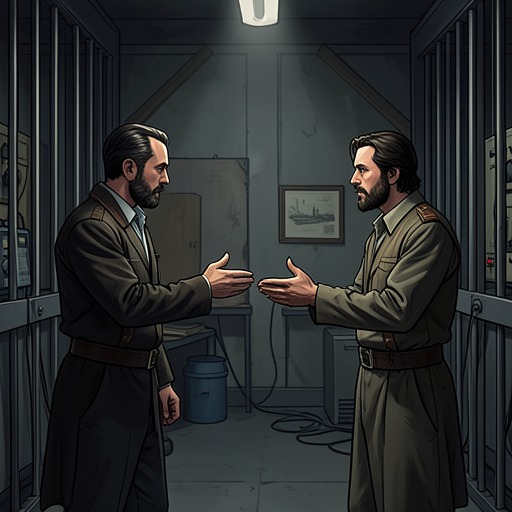
Kiss of the Spider WomanGender Roles and Domination in Sexual Relationships is developed both in a conversation between Molina and Valentin and in the novel’s later theoretical discussion of sexuality. Together, these passages show how unequal relationships can appear natural or even desirable when people have learned to associate masculinity with command and femininity with submission. Against that inherited script, Valentin argues that intimacy cannot justify domination: equality is the condition that keeps a relationship from becoming exploitation.
A Conversation About Equality
The idea takes shape through a personal exchange rather than an abstract debate. Valentin tells Molina that enjoying being a woman need not make Molina feel lesser, and that Molina need not compensate for it with favors, excuses, or submission. His response rejects the assumption that femininity carries an obligation to yield. The emphasis is not on denying Molina’s sense of herself, but on refusing to make that identity a reason for diminished standing.
Molina answers from a familiar marital model: if a man is a woman’s husband, he must give the orders to feel properly like a man of the house. In this account, a man’s authority is not an incidental feature of marriage but proof of his gendered role. Valentin counters that the man and woman of a household must be equals; otherwise, the relationship becomes a form of exploitation. The disagreement exposes the mechanism by which hierarchy is normalized: command can be treated as the natural expression of masculinity rather than as power exercised over another person.
Their exchange also reaches the intimate feelings that can make this arrangement seem attractive. Molina describes a frisson of fear in being embraced by a man. Valentin disputes the idea that a woman must be a martyr, and rejects the belief that being a man grants special rights. When Molina says the discussion is getting nowhere and wants to stop, Valentin says that, for him, it is going somewhere and he wants to continue. The difference matters: his effort is to unsettle a learned account of desire, while Molina’s response shows how difficult that account is to dislodge simply by naming it.
Gender as a Learned Social Script
The book’s theoretical commentary widens the conversation beyond the cellmates. Drawing on Dennis Altman, it describes Western sexual norms as doing two connected kinds of work: separating erotic feeling from activities not labeled sexual, and denying the human capacity for bisexual impulses. Within that framework, heterosexuality is treated as the unquestioned standard, while masculine and feminine conduct is presented as prestigious, proper, and fixed. The resulting roles are learned early and help preserve male supremacy.
Altman’s account also explains how gender identity is made relational. Men are taught to measure masculinity through the ability to conquer women, while women are taught to locate fulfillment in coupling with a man. The supposed identities of the two sexes thus reinforce one another: masculine authority requires a feminine counterpart expected to yield. This framework clarifies the force of Molina’s marital assumption. The man of the house is not simply an individual with a preference for control; his authority is supported by a larger cultural story that makes male command seem like the proper form of partnership.
Resistance and the Lack of Alternatives
The discussion of Anneli Taube adds a further complication: rejecting domination does not automatically provide a person with a free and equal alternative. Taube describes a sensitive boy’s rejection of an authoritarian father associated with weapons, competitive aggression, and disdain for sensitivity. Such refusal can be a meaningful rejection of the stronger, exploitative role. Yet the available alternative may be identified with the mother’s tenderness and tolerance while also remaining bound to her subordination within marriage. In Taube’s account, a girl may likewise reject the mother’s submissive position, only to find that the social roles available to her point toward becoming the oppressor instead.
The resulting critique is not that sensitivity or tenderness is itself submission. It is that a restrictive gender order packages desirable qualities together with unequal positions, leaving people with a false choice between being dominated and dominating. Taube regards the rebellion of boys and girls against these prescribed models as a sign of strength and dignity, even when the surrounding culture offers them few other patterns to follow.
Masculinity, Sexuality, and Compulsion
Taube’s account also treats gendered conduct as something that can be learned through imitation rather than chosen freely. She interprets patterns among homosexual men and women as reproducing, in altered form, defects associated with heterosexual roles: submission and a conservative preference for peace at any cost among men, and argumentative or anarchic behavior among women. The commentary presents these not as deliberate expressions of an essential nature but as compulsive patterns shaped by prolonged social conditioning, first through heterosexual models and later through models within homosexual life.
This analysis links private intimacy to the wider distribution of power. Altman condemns the strong-man ideal because it presents violence as evidence of masculinity and thereby helps sustain aggression. The commentary also notes that bisexual people face pressures from both exclusively homosexual and heterosexual forms of life, in part because they unsettle the presumed division between them. These claims frame gender roles not as isolated expectations inside a couple, but as a system that restricts the identities and forms of conduct people can imagine.
From Personal Respect to Political Critique
The ethical principle in Valentin’s conversation returns later as a direct appeal for Molina to insist on respect and not allow anyone to treat Molina badly or exploit Molina. Valentin acknowledges that he has made the point before and that Molina did not like hearing it then; the repetition gives the principle the force of a lesson carried forward between them. He asks Molina to promise not to be pushed around. In this way, equality becomes more than a theory about marriage: it is a standard for how Molina should be treated in relationships and in life beyond their exchange.
The theoretical discussion locates this personal concern within political change. It describes the women’s liberation movement of the 1960s as helping discredit the ideal of the strong man and the corresponding weak woman, roles that sexual outsiders had often been pressured to imitate. The later formation of homosexual liberation fronts is presented as evidence of that shift. Across the intimate dialogue and the broader analysis, the same conflict persists: a social order presents hierarchy as nature, while resistance begins by recognizing it as learned and refusing to grant one person authority over another on the basis of gender.